


"Any sufficiently advanced technology is indistinguishable from magic."
— Arthur C. Clarke
I’m an enthusiastic reader of fantasy books and particularly magic systems. I’m also an AI enthusiast – who isn’t these days, right? 🙂
After doing a lot of both recently, I noticed something fascinating – there were many parallels between magic systems in my favorite books and AI! So I seized the opportunity to geek out on magic systems and AI in the hopes of finding ChaiTime readers who also enjoy both.
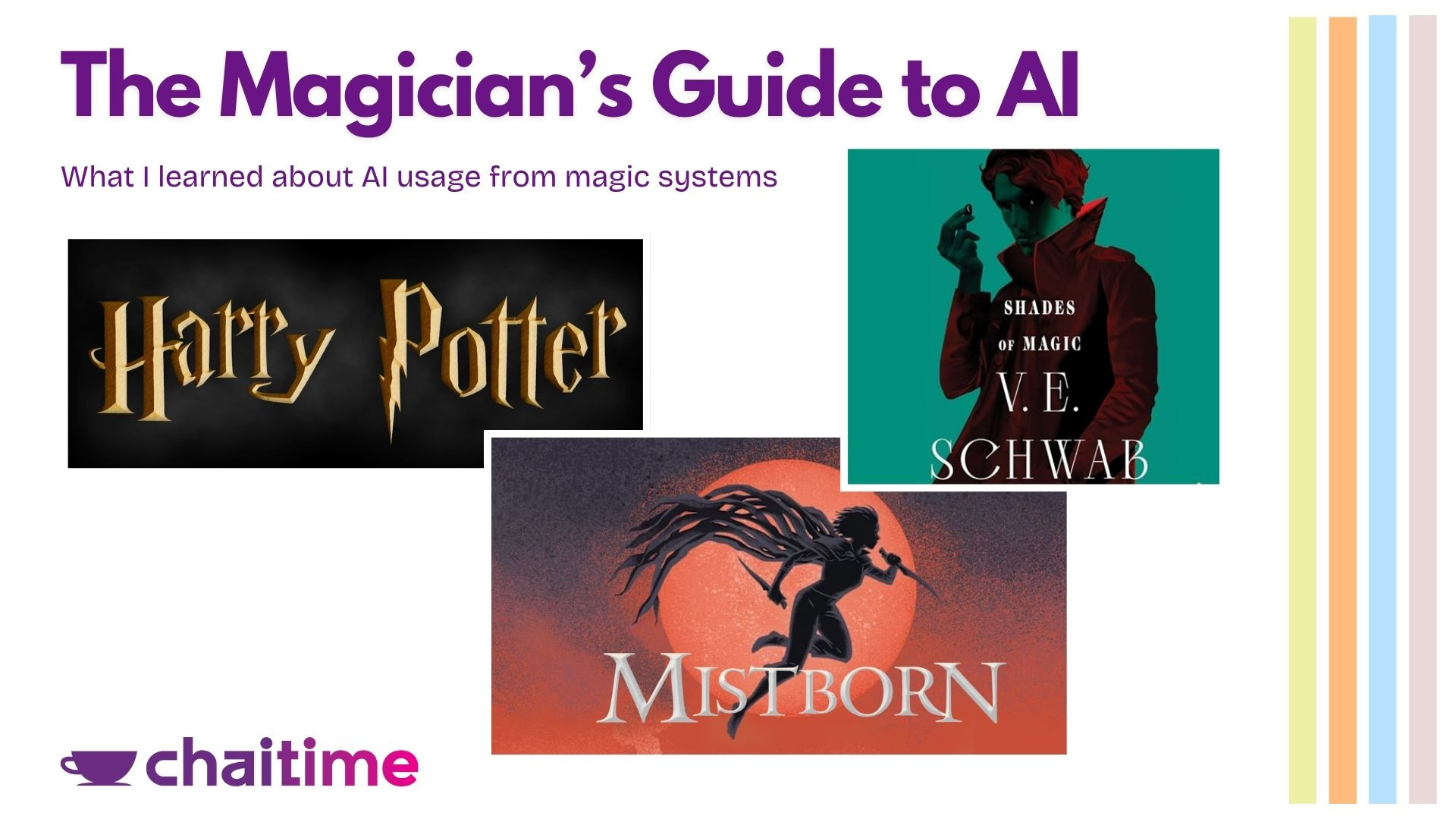
For the examples in this post I’ll focus on the following three fictional magic book series. I’ve indicated below how many books each series has if you are interested in reading some or all of them! I’d rate all of these at 5-star and have read many of them multiple times! There are also many other similar books I’ve read that I haven’t listed here but I’d absolutely recommend them. Happy to share more – just email me if you are interested!
Harry Potter series by J.K. Rowling (7 books)
Mistborn series by Brandon Sanderson (3 Era One books + 3 Era Two books + a few short stories in between)
Shades of Magic series by V.E. Schwab (3 books)
Here are seven key similarities I saw between fictional magic systems and AI.
1. Intent Is Everything
Magic: Every spell requires clear, focused intention. In Harry Potter, a half-hearted "Wingardium Leviosa" won't lift a feather. In Mistborn, Allomancers must have precise intent when Pushing and Pulling on metals—Vin learns that vague or unfocused Steel-pushing will send coins flying in random directions, but clear intention allows her to hit specific targets or launch herself with perfect accuracy.
AI: Similarly, AI responds best to clear, specific prompts. Vague requests yield vague results, while detailed intentions produce targeted outputs. Ask AI to "write something about marketing" and you'll get generic advice. Ask it to "write a 500-word email to potential customers explaining how our time-tracking software saves small business owners 2 hours per week" and you'll get a lot closer to your intended goal. The clearer your intent, the more powerful your results.
2. Every System Has a Cost
Magic: All magic usage comes with limitations and costs. Stormlight depletes, metals burn away, and magical energy isn't infinite. Users of the magic need to understand the price and use it wisely. This is often the cornerstone of drama in the various book plots where the protagonists need to manage tradeoffs and decide if/when to use magic. In Mistborn, Allomantic metals are consumed when burned and must be replenished. In Shades of Magic, using magic from the dangerous Black London comes with severe consequences.
AI: AI operations consume computational resources, energy, and often money. Understanding these costs helps users make strategic choices about when and how to deploy AI tools effectively. You shouldn’t use an expensive LLM to sort a spreadsheet alphabetically when Excel can do it instantly.
3. Mastery Requires Practice and Study
Magic: Hermione doesn't become the brightest witch of her age overnight—she studies constantly and practices spells repeatedly. In Mistborn, Vin starts knowing only how to burn pewter and tin, then gradually masters steel, iron, and eventually the more complex metals through dedicated training and experimentation.
AI: Effective AI use is a skill that improves with practice. Learning to craft better prompts, understanding different AI capabilities, and developing workflows all require dedicated effort and experimentation.
4. Know Your System's Rules and Limitations
Magic: Hard magic systems like Sanderson's have strict rules. Understanding these limitations isn't restrictive—it's what makes the magic predictable and powerful. In Mistborn, cadmium creates time bubbles where everything inside moves slower than the outside world—but clever characters like Marasi use this "limitation" strategically, slowing time within her bubble to buy precious moments until help arrives from outside.
AI: AI systems have specific capabilities and constraints. Understanding what AI can and cannot do, its potential biases, and its failure modes makes you a more effective user, not a limited one. For example, knowing that LLMs can hallucinate facts means experienced users ask for sources and verify important claims—but this same "limitation" makes them perfect for creative brainstorming where imagination and novel connections are more valuable than factual accuracy.
5. Unintended Consequences Are Always Possible
Magic: Magic often produces unexpected results. In Shades of Magic, the dangerous Black London serves as a reminder that magical power without wisdom leads to catastrophe. In Harry Potter, Voldemort's pursuit of immortality through splitting his soul demonstrates how using powerful magic without fully understanding the consequences led to unintended results that made him less human and ultimately caused his defeat.
AI: AI can generate biased outputs, hallucinations, or responses that miss crucial context. We have all heard stories of vibe coders faced with security problems or large bills due to unexpected high usage of paid APIs. Like careful spellcasters, effective AI users remain vigilant about unintended consequences.
6. Specialization Beats Generalization
Magic: Different magicians excel in different areas. In Harry Potter, Hermione excels at academic magic while Harry has a natural talent for Defense Against the Dark Arts. In Mistborn, some Allomancers are powerful Thugs (pewter burners) while others are precise Coinshots (steel burners).
AI: Different AI tools have different strengths. Some excel at writing, others at analysis, coding, or creative tasks. The most effective AI users learn to match the right tool to the right task.
7. Foundation and Fundamentals Matter Most
Magic: In all three series, understanding basic principles prevents dangerous mistakes. At Hogwarts, students must master fundamental wand movements and incantations before attempting advanced magic. In Mistborn, Allomancers must understand the basic physics of Pushing and Pulling before they can perform complex maneuvers. In Shades of Magic, magicians must first learn to sense and differentiate between the various types of magical energy.
AI: Understanding AI fundamentals—how these systems work, their strengths and weaknesses, and basic principles of effective prompting—provides a foundation for all advanced applications.
Conclusion: Your AI Spellbook
The next time you're crafting a prompt or exploring a new AI tool, think like a wizard: be clear in your intent, understand the costs, respect the limitations, and always stay curious about what's possible.
I'm feeling like a wizard now. ;D
Thanks for this perspective.
very simple yet fun comparison!